
Definition and scope of green building
Green building encompasses all design, construction, and operational practices that minimize the environmental impact of buildings throughout their entire life cycle. The building sector consumes 36% of global final energy and generates 37% of energy-related CO₂ emissions, according to the UNEP Global Status Report (2022). In light of these figures, green building proposes a framework of action based on five pillars: energy efficiency, water management, selection of low-impact materials, indoor environmental quality, and waste reduction. Buildings certified under standards such as LEED v4.1 or BREEAM International 2016 have demonstrated average reductions of 25-35% in energy consumption and 30-50% in water consumption compared to equivalent conventional buildings (USGBC, 2021). Global investment in green building reached 423 billion USD in 2023, with a compound annual growth rate of 10.3% since 2018 (Allied Market Research, 2024).
Green building is not limited to installing solar panels or using eco-friendly paint: it involves a systemic approach that spans from building orientation and the thermal envelope to the origin of materials and demolition waste management. Embodied carbon (carbon embedded in construction materials and processes) accounts for 11% to 23% of total life cycle emissions of a residential building with a 50-year service life (Röck et al., 2020). European regulatory frameworks are moving toward mandatory requirements: the recast EPBD Directive (2024) requires all new buildings to be zero-emission from 2030, and new public buildings from 2028. Green building has therefore evolved from a voluntary option to a progressive regulatory requirement in the European Union and in 85 other jurisdictions that already have mandatory energy efficiency codes for buildings (IEA, 2023).
International reference certifications and standards
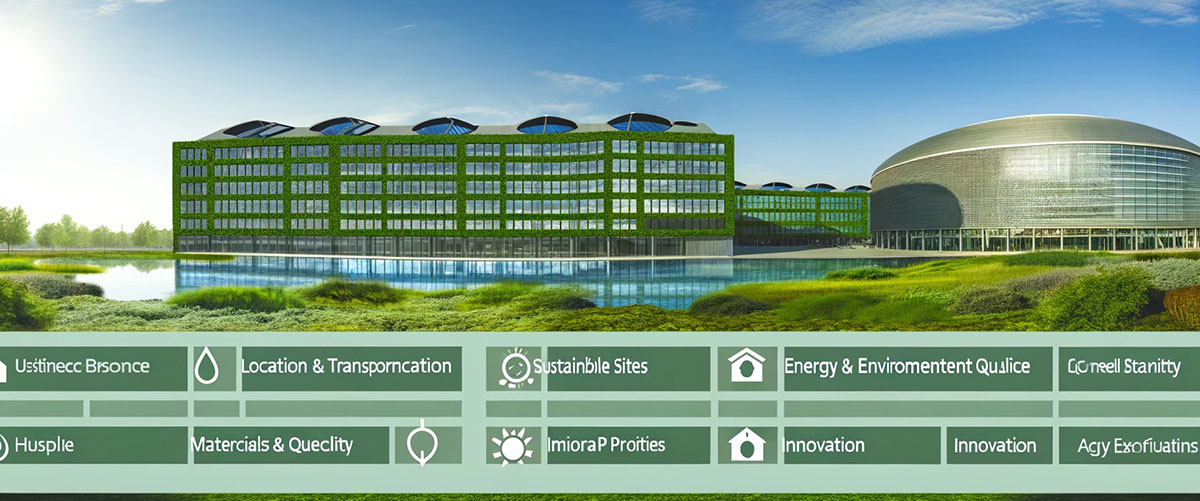
Sustainable building certifications provide measurable, comparable, and auditable assessment frameworks. LEED (Leadership in Energy and Environmental Design), developed by the US Green Building Council, is the most widespread system globally with more than 110,000 projects registered in 185 countries (USGBC, 2024). LEED v4.1 evaluates 9 categories with a maximum of 110 points: location and transportation, sustainable sites, water efficiency, energy and atmosphere, materials and resources, indoor environmental quality, innovation, and regional priority. The Platinum level (80+ points) is associated with energy reductions of 40-50% compared to ASHRAE 90.1-2019. BREEAM (Building Research Establishment Environmental Assessment Method), of British origin, has certified more than 600,000 buildings in 90 countries and evaluates 10 categories with weightings that vary according to building type and location.
At the European level, notable systems include: DGNB (Deutsche Gesellschaft für Nachhaltiges Bauen), with more than 9,000 certified projects and a 50-year life cycle approach that includes economic assessment; HQE (Haute Qualité Environnementale), predominant in France with 500,000+ certifications; and the European Commission's Level(s) framework, voluntary in application but progressively integrated into public procurement and the EU green taxonomy. The Passivhaus certification, although focused on energy demand, sets the most stringent standard: heating demand ≤ 15 kWh/m²·year, cooling demand ≤ 15 kWh/m²·year, airtightness ≤ 0.6 air changes/hour at 50 Pa, and primary energy demand ≤ 120 kWh/m²·year. The additional cost of building with certification ranges between 2% and 8% of the material execution budget, depending on the level and system chosen (World Green Building Council, 2019).
Quantified benefits of green building
The benefits of green building are distributed across three quantifiable dimensions. In the environmental dimension, certified green buildings reduce energy consumption by 25% to 50% (average of 33%), CO₂ emissions by 33% to 39%, water consumption by 20% to 30%, and construction waste generation by 50% to 70% (World Green Building Council, 2019). In the economic dimension, green buildings have operating costs 8-14% lower than conventional ones over a 20-year horizon, appraisal values 7-11% higher, and rental premiums of 3-8% (RICS, 2021). The full life cycle cost (LCC) of a green building is 14-20% lower than that of a conventional building when 30-50 years of operation are considered.
In the health and well-being dimension, the evidence is equally robust. A Harvard study (Allen et al., 2016) demonstrated that occupants of green buildings with improved ventilation (CO₂ < 600 ppm) and low concentrations of volatile organic compounds (TVOC < 50 μg/m³) scored 101% higher on cognitive function tests than occupants of conventional buildings. Sick leave in WELL or LEED-certified buildings with indoor air quality credits is reduced by 15-25% (IWBI, 2023). Workplace productivity improves by 8% to 11% in offices with good air quality, natural lighting, and thermal comfort (Wargocki et al., 2019). Green building, in summary, is not an added cost but an investment with quantifiable returns across all three dimensions of sustainable development.
Trends and the near future of the green sector
The green building sector is advancing toward three simultaneous frontiers. The first is total decarbonization: Net Zero Carbon Buildings (NZCB) offset 100% of their operational emissions through extreme efficiency and on-site renewable generation. The WorldGBC counts 180+ commitments from organizations to achieve net zero operational emissions across their building portfolios by 2030, and net zero life cycle emissions by 2050 (WorldGBC, 2023). The second frontier is the circular economy: 35% of waste generated in the EU comes from construction and demolition (374 million tonnes/year in the EU-27, Eurostat, 2022). Material passports, design for disassembly (DfD), and material banks enable reuse rates of 70-90% compared to the current 40-50%.
The third frontier is digitalization: BIM (Building Information Modeling), digital twins, and IoT sensors enable real-time optimization of building operations, with additional energy savings of 10-20% through predictive analytics. The integration of automated life cycle assessment (LCA) into BIM platforms — tools such as One Click LCA, Tally, or eLCA — facilitates embodied carbon evaluation during the design phase, when decisions have the greatest impact. The recast EPBD Directive requires a digital energy performance certificate indicating the global warming potential (GWP) of the life cycle for new buildings over 1,000 m² from 2028, and for all new buildings from 2030. Green building, far from being a passing trend, constitutes the structural evolution of the sector toward a model compatible with the Paris Agreement climate objectives (1.5°C) and the Sustainable Development Goals of the 2030 Agenda.
References
- [1]2022 Global Status Report for Buildings and Construction: Towards a Zero-emission, Efficient and Resilient Buildings and Construction SectorUnited Nations Environment Programme. ISBN: 978-92-807-3984-8
- [2]Bringing Embodied Carbon Upfront: Coordinated Action for the Building and Construction Sector to Tackle Embodied CarbonWorldGBC.
- [3]Embodied GHG emissions of buildings — The hidden challenge for effective climate change mitigationApplied Energy, 258, 114107.
- [4]Benefits of Green BuildingUSGBC.
- [5]Associations of Cognitive Function Scores with Carbon Dioxide, Ventilation, and Volatile Organic Compound Exposures in Office WorkersEnvironmental Health Perspectives, 124(6), 805-812.
- [6]Energy Efficiency 2023 — BuildingsIEA.
Comments 0
No comments yet. Be the first!
Leave a comment