
Hybridization Principles: Temporal and Spatial Complementarity of Renewable Sources
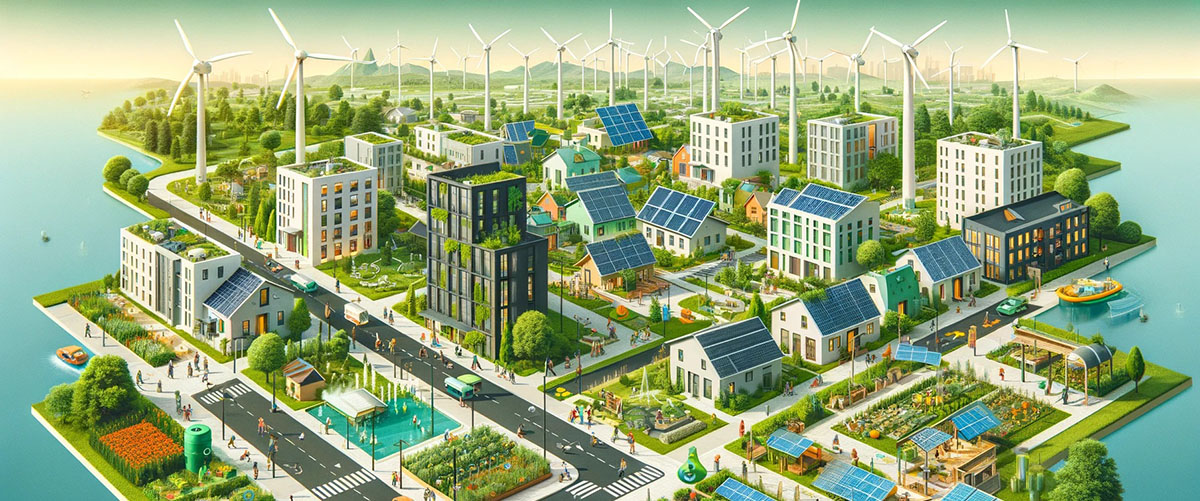
The strategy of merging multiple renewable energy sources in a building is grounded in temporal complementarity between resources: solar output peaks in summer (June-August: 6-8 kWh/m²·day in Spain) when wind is at its minimum; wind dominates in winter (November-March: 2,500-3,500 equivalent hours/year in coastal and mountain zones) when solar output is lower; geothermal and biomass provide a constant base throughout the year. A system combining these sources reduces storage dependency by 40-60% compared to a single-renewable system.
Spatial complementarity of the building allows assigning each surface to the optimal source: horizontal roof for photovoltaics (120-200 kWh/m²·year), roof and towers for small-scale wind (500-2,500 kWh/year per 1-5 kW turbine), subsurface for geothermal (vertical boreholes at 80-150 m, COP 4.5-6.0), basement/plant room for biomass boiler (85-93% efficiency), and south facade for solar thermal (400-700 kWh/m²·year per collector). The combined capacity factor of a well-sized multi-renewable system reaches 35-50%, compared to 15-20% for photovoltaics alone and 25-35% for wind alone. The standard ISO 52000-1:2017 provides the energy balance calculation framework that integrates multiple renewable sources.
Photovoltaics Plus Wind: The Most Widespread Combination
The photovoltaic plus wind hybridization is the most common combination in multi-energy buildings. Rooftop photovoltaic production (100-200 kWp in tertiary buildings of 2,000-5,000 m²) covers 30-60% of annual electricity consumption, with a generation profile concentrated during the central hours of the day (10:00-17:00). Urban small-scale wind (1-20 kW per turbine) complements nighttime hours and overcast days: vertical-axis wind turbines (VAWT: Darrieus, Savonius) start up at winds of 2-3 m/s, operate in turbulent urban flows and do not require wind orientation.
The production of a 5 kW VAWT in an urban environment (average wind speed 4-6 m/s at 15 m height) is 3,000-6,000 kWh/year. The Bahrain World Trade Center (2008) integrates 3 HAWT turbines of 225 kW between its two 240 m towers, generating 1,100 MWh/year (11-15% of the building's consumption). The Strata SE1 (London, 2010) incorporates 3 turbines of 19 kW at the crown of the 148 m building, generating 50 MWh/year. The photovoltaic plus wind hybridization with a lithium battery of 50-200 kWh achieves self-sufficiency rates of 70-90% in office buildings with consumption of 80-120 kWh/m²·year. The hybrid multistring inverter (SMA Sunny Tripower, Fronius Symo GEN24) simultaneously manages the photovoltaic, wind and battery inputs with conversion efficiencies of 96-98%.
Geothermal and Aerothermal Energy: The Renewable Thermal Base
Low-enthalpy geothermal energy (ground temperature: 12-18°C at 2-3 m depth, stable year-round) provides the thermal base of the multi-renewable building. Ground-source heat pumps (GSHP) with closed-loop vertical boreholes (PE100 polyethylene, 32-40 mm diameter, depth 80-200 m) achieve heating COP values of 4.5-6.0 and cooling EER values of 5.0-7.0, with a buried circuit service life of 50+ years. Drilling cost is 40-80 EUR/linear meter (3,200-16,000 EUR per 80-200 m borehole), amortizable in 8-15 years compared to a gas boiler.
In multi-energy buildings, geothermal is complemented by solar thermal for DHW: evacuated tube collectors (60-75% efficiency) cover 50-70% of DHW demand in summer and 20-35% in winter, while the ground-source heat pump supplies the remainder. The The Edge building (Amsterdam, 2015, PLP Architecture, BREEAM Outstanding 98.36%) combines 4,100 m² of photovoltaics on the roof and south facade (generation: 500 MWh/year), aquifer thermal energy storage (ATES: 1,500 MWh/year of cooling + heating), and 30,000 IoT energy management sensors, achieving a consumption of only 70 kWh/m²·year — 70% below that of conventional offices. The seasonal thermal energy storage system (BTES/ATES) stores excess summer heat in the aquifer and recovers it in winter, with recovery efficiencies of 60-80%.
Biomass, Biogas and Micro-Cogeneration: Dispatchable Renewable Sources
Biomass and biogas contribute the most valuable characteristic to a multi-renewable system: dispatchability — the capacity to generate energy on demand, regardless of meteorological conditions. Biomass boilers (wood pellets: NCV 4.5-5.0 kWh/kg, moisture <8%) achieve efficiencies of 90-95% with biogenic CO₂ emissions (carbon-neutral cycle) and particulate matter controlled by bag filters (emissions <20 mg/Nm³ PM). Pellet cost is 0.04-0.06 EUR/kWh (250-350 EUR/tonne, 2024), competitive with natural gas (0.05-0.08 EUR/kWh).
Micro-cogeneration (micro-CHP) generates electricity and heat simultaneously with a combined efficiency of 85-95%: Stirling engines (1-10 kWe, such as Viessmann Vitotwin, Ökofen Pellematic Condens_e) or SOFC fuel cells (0.7-5 kWe, BlueGEN, Viessmann Vitovalor) fueled by natural gas, biogas or hydrogen cover the base electrical and thermal demand of the building. The Bullitt Center (Seattle, 2013, Miller Hull Partnership) — dubbed "the greenest commercial building in the world" — combines 242 m² of rooftop photovoltaics (production: 60 MWh/year), rainwater harvesting (570 m³/year for all uses), waste composting, and passive ventilation and lighting systems, generating more energy than it consumes (Energy Use Intensity: 16 kWh/m²·year, Living Building Challenge certification). The Bosco Verticale (Milan, 2014, Stefano Boeri) integrates 900 trees and 20,000 plants on its facades with geothermal, photovoltaic and solar thermal systems, demonstrating that renewable hybridization is compatible with urban biodiversity.
Intelligent Management and Sizing of the Multi-Renewable System
Optimal sizing of a multi-renewable system requires hourly simulation (8,760 hours/year) that models: electrical and thermal demand profiles of the building, production of each renewable source with typical meteorological year data (TMY), storage capacity (electrical battery + thermal accumulator) and dispatch strategy (priority self-consumption, grid export, storage). The tools HOMER Pro (NREL) and RETScreen (Natural Resources Canada) optimize the renewable mix by minimizing the levelized cost of energy (LCOE) or maximizing the self-sufficiency rate.
The energy management system (EMS) controls the real-time dispatch of each renewable source. Model Predictive Control (MPC) algorithms use 24-72 hour weather forecasts and demand models to optimize battery charge/discharge, biomass boiler activation and grid interaction (off-peak purchasing, peak-time selling). An EMS with MPC reduces energy cost by an additional 15-25% over a system with fixed rules. The building microgrid — with the capacity to operate in island mode during grid outages — requires a grid-forming inverter with black start capability. The certifications LEED EA (up to 18 points for energy performance optimization), BREEAM Ene 01-04 (up to 15 credits) and Living Building Challenge (Net Positive Energy) incentivize multi-renewable integration with coverage targets of 100-105% of annual consumption.
References
- [1]Renewable Energy Systems: A Smart Energy Systems Approach to the Choice and Modeling of 100% Renewable SolutionsAcademic Press, 2nd ed.. ISBN: 978-0-12-410423-5
- [2]Smart Energy Systems for coherent 100% renewable energy and transport solutionsApplied Energy, 145, 139-154.
- [3]Bullitt Center: Performance Documentation and Living Building Challenge CertificationBullitt Foundation.
- [4]The Edge, Amsterdam: Design and Performance Report — BREEAM Outstanding 98.36%PLP Architecture / OVG Real Estate.
- [5]World Energy Transitions Outlook: 1.5°C PathwayInternational Renewable Energy Agency. ISBN: 978-92-9260-334-1


Comments 0
No comments yet. Be the first!
Leave a comment